Candle manufacturer in France: the B2B buying guide to choosing well
The scented candle market is booming, and more and more brands — cosmetics, decoration, hospitality, concept stores — want to launch their own range. Everything then rests on one decisive choice: the production partner. Finding the right candle manufacturer in France isn’t just about price: it’s a commitment to your product quality, your regulatory compliance and your time to market.
- The MOQ (minimum order)
- CLP & IFRA compliance
- Fragrance quality (Grasse)
- Production lead times
- Scope of customisation
- Advice and support
- Proximity and same language
- Regulatory security
- Short re-order lead times
- Lower transport footprint
- Workshop visits possible
Why choose a candle manufacturer in France?
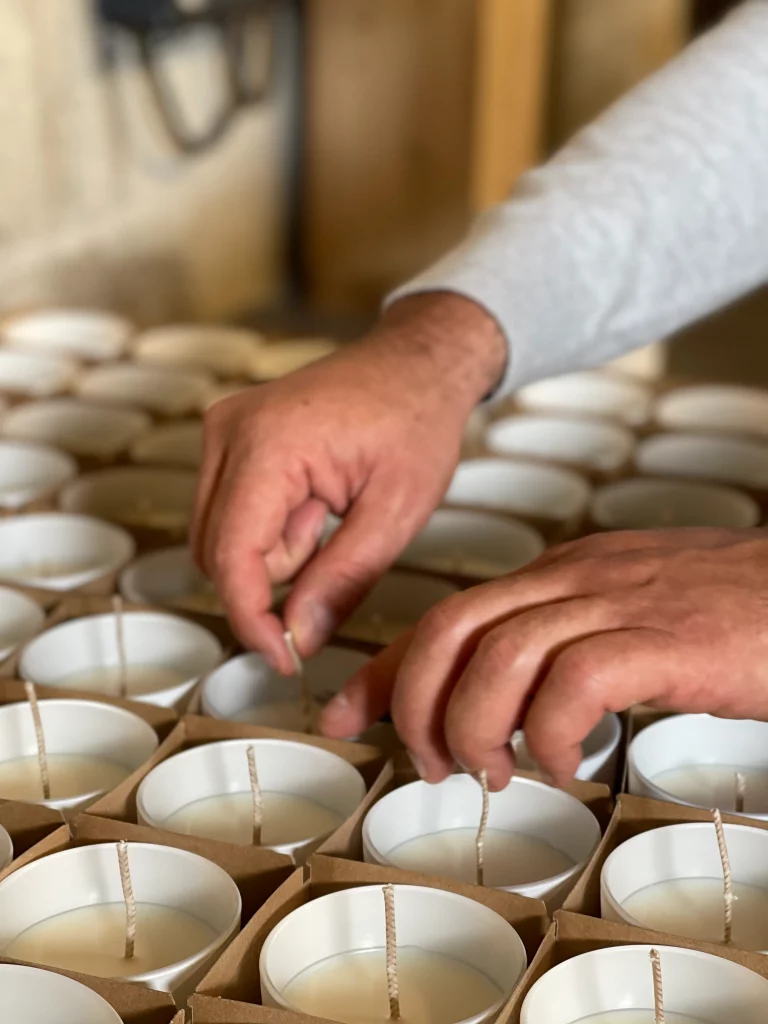
Producing in France isn’t just a ‘made in France’ marketing argument. It’s first a guarantee of proximity: you communicate in your language, you can visit the workshop, validate samples quickly and adjust a formula with no time-zone gap. It’s then regulatory security — a French manufacturer masters the European CLP regulation and IFRA standards, essential to legally sell a scented candle.
Finally, local manufacturing reduces transport’s carbon footprint and shortens your re-supply lead times, a decisive advantage once your brand starts to scale. Against Asian imports that are often cheaper but riskier, a candle manufacturer in France secures your value chain.
Maker, contract manufacturer or industrial: which type?
The French landscape includes several profiles. The maker chandler works in very small runs, with great creative freedom but limited capacity. The contract manufacturer — or white-label manufacturer — specialises in producing for other brands: often the best compromise between quality, flexibility and volume. The industrial one, finally, targets large runs at tight prices, but with high MOQs and little custom work.
For a brand launching or growing, the French contract manufacturer — able to produce from small runs up to several tens of thousands of units — is generally the most suitable partner. Identify your need profile before even requesting a quote.
The MOQ (minimum order)
The MOQ governs your ability to start without overstock. Some industrials only accept orders from several thousand units, which is out of reach for a young brand. Conversely, a flexible partner offers short runs: a candle manufacturer like MA CONCEPTION, near Lyon, produces for example from 50 units, then supports the ramp-up to several tens of thousands of units. Also check the MOQ per fragrance and per vessel, often more restrictive than the overall MOQ.
Regulatory compliance (CLP, IFRA)
A scented candle sold in Europe must comply with the CLP regulation (labelling of hazardous substances), provide a safety data sheet and respect IFRA thresholds for each fragrance. A serious manufacturer integrates this compliance into its service and provides the necessary documents. Ask whether burn, flame-stability and safety tests are carried out. Without these guarantees, it’s your brand that bears legal responsibility if a problem arises.
Fragrance quality (Grasse)
Fragrance makes up 80% of a candle’s perception. The global reference remains Grasse, the cradle of French perfumery. A candle manufacturer in France working with Grasse houses gives you access to high-quality scents with good cold and hot throw. Beyond the catalogue, check whether the partner can develop an exclusive signature fragrance for your brand — a real point of differentiation.

Production lead times
A beautiful product delivered too late means a missed commercial season. Ask for average lead times between final sign-off and delivery, as well as the manufacturer’s ability to handle your peaks (Christmas, Mother’s Day, launches). Local production works in your favour here: no weeks-long sea freight and no customs hold-ups.
The scope of customisation
Your brand needs a product that resembles it. Assess the scope of possible customisation: wax type (rapeseed, soy, beeswax, plant-based), vessel choice (glass, ceramic, format), colour, wick (cotton or wood), label and packaging. The more the manufacturer masters these steps in-house, the more coherent the result and the more controlled the lead time.
Advice and support
A good manufacturer is also an advisor. It guides you on the wax/fragrance pairing, wick sizing, regulations and vessel sourcing. For a brand launching out, this support is often worth more than a few cents saved on the unit price.
White label or custom: which approach?
Two main approaches exist. The white-label candle starts from an existing product that you dress in your colours: fast, economical, ideal for testing a market. The custom candle builds the product from A to Z (formula, vessel, exclusive fragrance): longer and more committing, but it creates a unique, hard-to-copy product. Many brands start in white label then switch to custom as they grow.

How much does candle manufacturing cost in France?
The unit price depends on volume, wax, vessel, fragrance complexity and packaging. In small runs, expect more per piece; the cost drops sharply with volume. Be wary of an abnormally low quote: it often hides a lower-quality wax, a diluted fragrance or missing compliance. Ask for a detailed line-by-line quote to compare like with like.
Mistakes to avoid when choosing your manufacturer
First mistake: looking only at the unit price. A very low quote often masks a low-grade wax, a reduced fragrance load or missing compliance — all risks to your image and legal responsibility. Second mistake: neglecting samples. Before any order, insist on real prototypes and test flame stability, cold and hot scent throw and burn duration.
Third mistake: forgetting scalability. A manufacturer perfect for 100 candles may be unable to keep up when your brand takes off; check its ability to scale volume without changing the formula. Finally, be wary of a partner that asks no questions about your project: a good candle manufacturer in France first seeks to understand your positioning and target before quoting.
Choosing a candle manufacturer in France means choosing a long-term partner, not just a subcontractor.
Flexible MOQ, CLP compliance, Grasse fragrances, controlled lead times and real support: these criteria make the difference between a brand that lasts and a failed launch. Have a candle project to launch? Contact us to discuss your specifications and get a tailored quote.
Your questions about choosing a manufacturer
It varies by manufacturer: from several thousand units at industrials to just 50 units at flexible partners like MA CONCEPTION. Always check the MOQ per fragrance and per vessel, often more restrictive than the overall minimum.
Yes. Any scented candle marketed in Europe must comply with the CLP regulation (labelling), have a safety data sheet and respect IFRA thresholds for each fragrance. A serious French manufacturer integrates this compliance into its service.
Grasse is the world capital of perfumery. Grasse scents offer superior olfactory quality and throw (both cold and during burning), and make it possible to develop an exclusive signature fragrance for your brand.
After final sign-off, expect a few weeks with a manufacturer in France — much faster than an Asian import subject to sea freight and customs. Exact lead times depend on volume and customisation.
Launch your range with a French manufacturer
French manufacturer near Lyon, flexible minimum order from 50 units, CLP compliance and Grasse fragrances. Reply within 24h.