Custom candles: behind the scenes of creation, from idea to finished product
Behind every beautiful branded candle lies a meticulous process the end customer never suspects. Creating a custom candle isn’t about picking a product from a catalogue: it’s about designing, step by step, a scented object that embodies a brand — from the first idea to the finished, packaged product. We take you behind the scenes: creative brief, vessel, Grasse fragrance, prototyping, production and packaging.
- The creative brief
- Choosing the vessel
- The Grasse fragrance
- Prototyping & testing
- Production
- Packaging & finishing
- A truly unique product
- An exclusive fragrance
- Higher perceived value
- Full control over quality
- A lasting brand asset
Why choose a custom candle?
Choosing custom over an off-the-shelf product answers a clear goal: owning a product no one else can sell. Where a standard product appears identically across several brands, a custom candle carries your vessel, your fragrance and your world — a unique asset that protects your positioning and feeds your brand storytelling.
It’s also a lever for perceived value: an object considered down to the last detail justifies a higher price and builds loyalty. Finally, custom gives you full control over quality and compliance, from the choice of wax to the labelling. For a brand that wants to last and stand out, it’s rarely an expense: it’s an investment in its identity.
The creative brief: it all starts with intent
Before the first drop of wax, there is a brand and a story. The creative brief is the founding document: it defines the brand’s world, its target, its positioning (entry-level, premium, luxury), the volumes envisaged, the budget and above all the olfactory direction sought.
It often comes with a moodboard, references and constraints (plant-based wax, made in France, refillable vessel…). The manufacturer’s role is to translate this sometimes vague intent into a precise technical roadmap. The clearer the brief, the more faithful and faster the creation: it’s the most strategic stage of the project.
Choosing the vessel
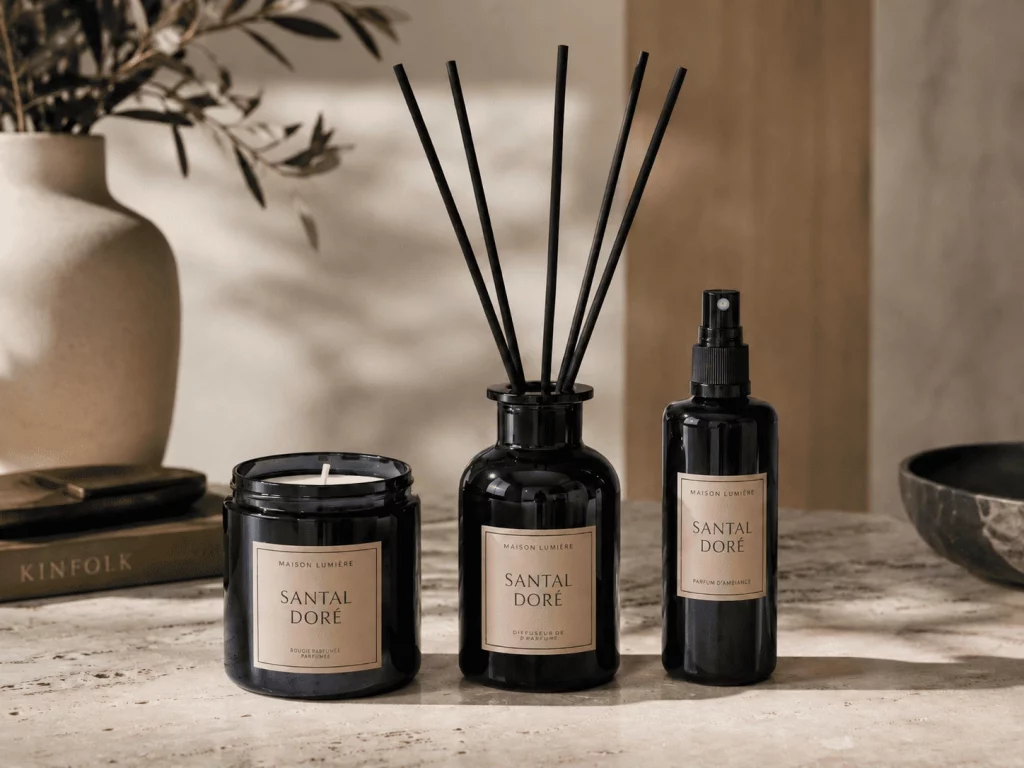
The vessel is the first thing the customer sees and touches: it carries 50% of the product’s perception. Glass, ceramic, concrete, metal: each material tells a story. You then choose the shape, size, colour and finish (frosted, lacquered, matte glass), then the marking techniques — screen printing, engraving, label.
The vessel also influences the burn: its diameter determines wick sizing. A good manufacturer helps you arbitrate between aesthetics, technical constraints and budget, and secures sourcing to guarantee long-term availability.

Formulating the fragrance in Grasse
This is the beating heart of the project. Fragrance carries most of a candle’s emotion, and the global reference remains Grasse, the cradle of French perfumery. From the olfactory brief, perfumers build an accord by working the pyramid — top, heart and base notes — then refine through successive iterations until the scent is validated.
Natural and synthetic materials are balanced, hot and cold throw are controlled, and IFRA compliance is ensured. The ideal outcome is an exclusive signature fragrance that belongs only to your brand and that no one can copy — a powerful, lasting point of differentiation.
Prototyping and testing
A formula on paper is worth nothing until it has burned. You first choose the wax (soy, rapeseed, coconut, blend), then size the wick (cotton or wood). Then come the test pours and an essential curing time, before the burn tests: flame height and stability, no tunnelling, smoke, and above all cold and hot scent throw.
Each parameter is adjusted, and it usually takes several rounds before achieving a candle that burns cleanly from start to finish. This invisible rigour makes all the difference between an amateur product and a professional creation.
Production
Once the final sign-off is validated, series production begins. In our candle-making workshop near Lyon, each batch follows a precise protocol: wax preparation, fragrance dosing, wick centring, temperature-controlled pouring, curing, then quality control and labelling.
Local manufacturing allows close monitoring, fast adjustments and controlled lead times — a decisive advantage over imports. Batch-to-batch consistency is the essential promise made to your brand.

Packaging and finishing
The final step shapes the customer experience. Sleeve, gift box, wrap, tissue paper: packaging extends the brand’s world and elevates the unboxing moment, now a ritual on social media. It’s also where the mandatory regulatory mentions live — CLP labelling, pictograms, safety advice — which a serious manufacturer integrates leaving nothing to chance. Coherent, eco-designed packaging increases perceived value and justifies the price positioning.
How long does it take to create a custom candle?
From brief to first delivery, expect anywhere from a few weeks to a few months depending on complexity: formulating an exclusive fragrance and sourcing a specific vessel lengthen the timeline, while a more standardised project moves faster. Planning ahead is crucial if you’re targeting a specific commercial season (Christmas, Mother’s Day, a collection launch).
Custom or white label: which to choose?
Not every project requires full custom. The custom candle builds the product from A to Z for a unique, hard-to-copy result: ideal for a brand that wants a true signature. But if you’re after speed and economy to test a market, go for white label: you start from an existing product that you dress in your colours. Many brands combine both depending on the range.
Mistakes to avoid in a custom project
First mistake: starting without a clear brief. A fuzzy project multiplies back-and-forths, lengthens lead times and dilutes the result; take the time to set your world, your target and your budget. Second mistake: validating a fragrance on a simple smelling strip, without a real burn test — a scent that’s seductive when cold can disappoint once the candle is lit.
Third mistake: underestimating the vessel and its sourcing; a beautiful flacon unavailable in six months can block your re-orders. Finally, don’t neglect regulations (CLP, IFRA): it’s your brand that bears responsibility. A good manufacturer plays the role of creative partner here, not just an executor.
From idea to finished product, creating a custom candle mobilises manufacturership at every stage — and that's precisely what makes the difference on the shelf.
Creative brief, vessel, Grasse fragrance, rigorous testing, local production and careful packaging: every link builds your product’s value. Have a creation project? Let’s talk and build your signature candle.
Your questions about custom candles
From brief to first delivery, expect a few weeks to a few months depending on complexity. Formulating an exclusive fragrance and sourcing a specific vessel lengthen the timeline; a more standardised project is faster.
It depends on the manufacturer. Flexible partners accept short runs (for example from 50 units) then support volume growth. Check the MOQ per fragrance and per vessel, often more restrictive than the overall minimum.
Yes. Beyond the catalogue, a manufacturer working with Grasse perfumers can develop an exclusive signature fragrance that belongs only to your brand and becomes a true point of differentiation.
Let's bring your signature candle to life
French manufacturer, flexible minimum order, Grasse fragrances. From idea to finished product, we support you at every step. Reply within 24h.